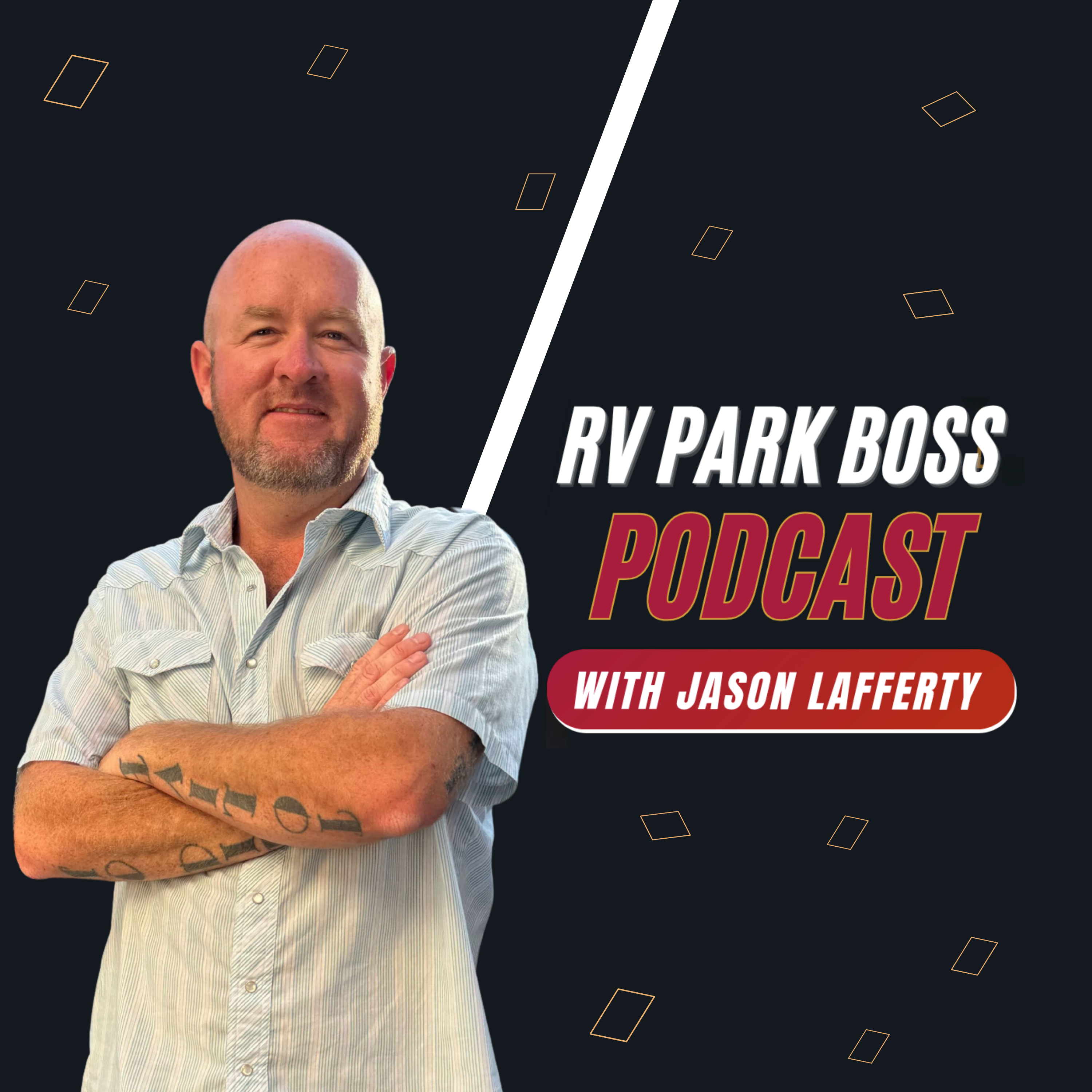
[00:00:02] Speaker A: Welcome to RV Park Boss, a podcast for RV park owners. I'm your host Jason Lafferty. This is a show where we dive deep in the challenges and rewards for park ownership and some funny stories along the way. This podcast is sponsored by RV Park Pros. 78 of all RV parks are self managed mom and pop operations. So aside from location, strong marketing, guest experience and proactive management, all those are keys to success and profitability for any parks. So if you're still trying to keep up with this all by yourself, there is a better way. RV Park Pro is a park management system that helps you maximize your occupancy and profits while optimizing your guest experience and retention. All with you not having to be involved in the day to day. So if you have any interest in learning more about how we can streamline your operation, you can reach
[email protected] Today's RV park boss is Vit Mesa. He works directly with mobile home park buyers for from looking at leads with them all the way getting them to the closing table. So how we doing today sir? Thanks for being here.
[00:00:57] Speaker B: Thank you for having me.
It was nice meeting you a few months ago in Dallas. So we have.
Good chat.
Good chat. Walk your project. So really fascinating.
[00:01:12] Speaker A: Yeah, yeah, it's. It's a fun world that we're in.
You know, I think you focus more on mobile home parks versus RVs.
[00:01:18] Speaker B: Right.
I. I mean I do both to be honest. We do have acquisitions that are doing both to be honest.
T is the most seller that we have actually interested in selling actually our RV parks owner.
But in the other end I will say mostly the buyers, the most buyer that I do that we do have are for Bob on parks at the moment at least when I say the most answer, the most experience, I mean ready to go and you know, with capital in line, you know, thing.
[00:01:55] Speaker A: Yeah. Not tire kickers. So that's funny. So. So we're seeing more people that want to sell RV parks but we're seeing less people want to sell mobile home parks but more buyers for mobile home parks, I guess.
[00:02:05] Speaker B: Correct. Yeah.
[00:02:06] Speaker A: The idea, the stability, predictability and affordable housing. I guess.
[00:02:11] Speaker B: Yeah. I will say at least from my understanding because actually every park is a real business so you know, it makes more attractive you to stay mobile home park because it's a little bit more passive.
[00:02:27] Speaker A: Yeah, yeah, for sure. So this. So when you're working with your buyers this past year, what are some changes in the questions that they're asking and the kind of their thought process when they're looking for mobile home park acquisitions.
[00:02:40] Speaker B: I mean the last year I was saying do not joke around. I mean the. Go straight up to cap rate and see the spread between the cap rate, at least the current interest rate.
Interest rate.
Obviously if, if I'm going back one year from here. We, we were. Everyone was under the impression that the industry will go down instead.
So.
So it's a different type of conversation.
And I see at the same time, yeah, I would say it's more around capital than the part per se I would say because I feel like they're ready to buy anything.
So.
So it's more experienced buyer coin lower in the count pad. So they're also for 30, 40, 30, 40 bad, which is uncommon. At least they try to be at least 50.
Sometimes it's more 100. But.
But I'm seeing lower count open to the discussion by more capital focus.
I would say so.
[00:03:53] Speaker A: Yeah, yeah, more focused on the cash return.
[00:03:56] Speaker B: Instead of the asset. Yeah. Instead of the asset. Yeah. Ca.
This is what we have to do. And I see a lot more of sort of finance at least in second position instead of, you know, a full owner finance, at least a little bit of second position or refinance.
[00:04:11] Speaker A: Are you talking about the sellers being. Being in second? Yeah, yeah, yeah, that's, that's, that's pretty neat when you get in those situations because nobody wants to be in second.
But if, if you position it well. And I think if the buyer, if they, you know, bring the right cash or the right structure to the, to the deal to make them feel comfortable with it and they believe in the operator, I guess that's how you can, you can, you can do it.
Because, because if the seller is a second lien position, I would imagine they'd want, you know, to know that you're going to invest some money into the park or you know, bring in some more, more units or something like that.
[00:04:46] Speaker B: Yeah, at the end of the day it's more of, you know, the double. If the down payment is really strong, they're more open to it. But, but we see a lot of quote unquote experience. I mean, you have to start from, from somewhere. But the new buyers are coming in, you know, hoping to get the service a composition but with almost no money down.
So at that point, yeah, we're going to see the seller say, hey, I mean, what are we talking about?
I mean, even if we see a lot of people, you know, right now in social media and Instagram, not talking bad about them, but, you know, just promoting this stuff, you know, no money down, no, no, nothing you can get on, you know, RV park, passive and all that stuff. I'm not talking about, but real reality is for us that we are in the trend. Just talking to sellers and buyers, I mean, doesn't really happen that way.
So yeah, it's really, it's really rare, super rare that you can just go no money, no money down or just a low down. They try to aim for 10% and sell her in second position.
[00:05:55] Speaker A: So.
Right.
[00:05:57] Speaker B: They're really, really, really rare deals.
[00:06:03] Speaker A: Yeah, yeah, yeah, that's for sure. Everybody wants everybody to have some skin in the game. For sure.
Do you work with people like particular park sizes or demographics or will you look at a 10 site park and then a 200 site park all over
[00:06:17] Speaker B: the map over the last year we open it up a little bit just because obviously the market is stabilizing a little bit. So by opening a little bit we were just aiming for 50 plus two years ago, but right now we just downsize a little bit. We open 20 actually. There's, I mean there's also new buyers that are coming in with financing already. Already and they're open to 10 lots, six lots. So we are just, you know, just going with the flow and just going a little bit down.
[00:06:50] Speaker A: Yeah. Deal to deal.
[00:06:51] Speaker B: Yeah, exactly.
[00:06:52] Speaker A: A lot of people ask me about RV parks and what's your, your buy box? I'm like, oh, it's, I don't like to be all over the place. I don't really give a shit. Like if it's a 10 side park and I can expand it and I can get it for pennies on the dollar, I mean, why, why wouldn't you do it? In my opinion, if obviously it's operational, a time thing. But if the numbers are there.
I'm looking at this park in South Texas right now and it's a bunch of vacancy, but we'd have to get it and completely change the dynamics of it. But it's only $175,000 and. But if I can go in there and work some deals with some local workforce housing and bring in a dozen units, then that thing is going to be worth a million bucks in a year.
[00:07:30] Speaker B: So I don't care.
[00:07:32] Speaker A: It's only a few paths, you know, but, but it is nice to do the big ones too where there's a lot of operational improvements and things that you can do.
[00:07:38] Speaker B: So yeah, everyone aims for those big ones. So yeah, so everyone is ready. I mean, I mean maybe RV parks are the less ready to go. But I mean, there's a few big operators, you know, they're going to.
I feel like RV parts is going to be the next big thing.
[00:08:00] Speaker A: You think so?
[00:08:01] Speaker B: To be honest. Yeah, I think. I mean, I think so.
It's getting, I mean, buyers, buyers starting to get into RV parts. I mean they try to look at it with rent control coming. I was actually talking to a buyer in Pennsylvania.
They have like 25 parts just in Pennsylvania and rent control is coming. So right now I'm open, you know, to chat about RV bike. So I see a little bit of shift.
[00:08:36] Speaker A: Yeah, so. So what, what is it? What do you. Can you elaborate more on rent control coming and then what that's going to mean in the RV park and mobile home industry space?
[00:08:45] Speaker B: Yeah.
So basically the government is going to go come in and just cap the rent increase every year. So it's gonna be a little bit hard. For example, maybe around 2, 3% rent increase.
So the owner, the owner of the mobile park can only increase the rent for 3%. So it's gonna be hard for them. Keep with the maintenance, obviously, because at the end of the day the rent lot ra is for maintenance and stuff and stuff. So is so coming in into something that we see a lot common in this parks that are moment pop operator. They never raise rents and they keep the reins, you know, for less than years.
And basically they have to come in and try to get to market rent. But with a 3% rent increase, you cannot do that. So it's going to take forever actually. Either you probably won't even.
You won't even get to more rent because obviously the price is going to increase with the time. So I mean the expense and all this stuff. So.
Yes. So right now rent control is a real thing.
[00:10:04] Speaker A: Is that a federal bill that's being passed or anything? I haven't been paying attention to it.
[00:10:11] Speaker B: I'm not, I'm not sure, but.
I'm not sure to be honest. But when I talked about. They're really concerned about it.
So it's not like some. Some kind of suggestion. You know, they're really, they're really, they're really concerned about it and they're on the fence to buy more parts.
So right now there's a little bit of mismatch between seller expectation, bar expectation, so that everyone is waiting.
So.
[00:10:43] Speaker A: Yeah, interesting.
[00:10:45] Speaker B: So that's what I'm seeing as at least in the mobile park space instead in RV parks.
I mean, by talking to. I was talking to Robert Preston actually maybe a Martian today. But he was telling me that's gonna come in a lot of foreclosure and stuff. So it's actually building a fund just for, to buy for closed park for cruiser parks. So RV or mobile RV parks, especially RV parks. Yeah.
[00:11:12] Speaker A: Yeah.
[00:11:13] Speaker B: So we are seeing a lot of foreclosure on RV parks. All this distress situation instead for sellers, the mobile parts sellers are not really distressed.
[00:11:26] Speaker A: Yeah.
[00:11:26] Speaker B: In general, even if the park is vacant, they're not really distressed.
So that's a really strange thing. Yeah, they're not really distressed. They might, I, I can see that in another five years and study for the president one.
So.
[00:11:40] Speaker A: Yeah, that's interesting.
Yeah. So it's I guess mobile homes, I guess the idea is because they have usually typically better cap rates is that they're a little more stable than RVs RV parks. But that's where I see the opportunity in my eyes is find those little park parks, big parks, small parks that where you can make some operational shifts or some just like uses of your of of your lots shifts and just different things to kind of shift and make it more profitable.
[00:12:14] Speaker B: Yeah.
But really there are reports space, I mean it's so dynamic. You can just go with different ideas and make, you know, just increase your noi with a bunch of new ideas. Instead you don't have that creativity, flexibility in the mobile park space.
[00:12:33] Speaker A: I mean I think not as much for sure.
[00:12:38] Speaker B: Yeah.
[00:12:39] Speaker A: Because rv, you just tell them to leave, they pack their stuff up and leave. But if it's a tenant owned mobile home, if they can't afford 400 a lot rent then they're not going to afford $4,000 and to move their unit out their mobile home. So that's definitely a little shift there and you have those costs.
[00:12:57] Speaker B: I was, I was talking actually about ace with another buyer out in Louisiana. I was telling me, hey, you have to be really firm and just keep them out.
No, nothing. Because at the end of the day he's charging 300 bucks, three band bucks a month. So it's really class C tenants and it's like, it's like what, you can just pick him one more shift at the end of the day. Just one more shift and then you have 200 bucks.
So at the end of the day you're lazy.
So it's, it's really, it's really firm about it.
[00:13:35] Speaker A: Yeah, yeah. What's tough. But you gotta, you gotta be like you said, you gotta be firm because if not people just walk all over you.
[00:13:43] Speaker B: Yeah,
[00:13:45] Speaker A: that's not the, not the fun part. In this business, having to evict people and get nasty with them, like, are you gonna pick your up and get out or are we gonna have to walk you out? Like, what's going on here?
[00:13:56] Speaker B: Oh, yeah. Oh, they're really serious about it. I mean, I can understand maybe in Cali, where they have higher lot rent. A thousand, fifteen hundred lot rent. So yeah, maybe it's a little bit sticky also with dialogues.
But you know, in other markets it's like, hey, I mean, you can do better than this and be a welfare.
[00:14:18] Speaker A: Sure. More for me, is there any, Sorry, is there any areas for mobile home parks that you like, like states or kind of general areas? And then is there any areas that you don't like?
[00:14:30] Speaker B: So personally, personally, I'm going to follow just the buyer because buyers knows better. But I, I'm. See most of the buyers go to the Southeast, so. Southeast, I mean, North Carolina, South Carolina, Tennessee, Georgia, Alabama, Texas and Florida.
So everyone is, I mean, everyone is going there.
There's a little bit more in the Midwest just for the prices, but.
But everyone is there. Actually, I was talking to a big, huge, huge operator that they have. They have like, you know, more than 10,000 lots and they just, they bought maybe three, 25 parks already this year.
So he was telling me I'm selling everything that I spread around. I'm just relocating everything in the Southeast.
[00:15:27] Speaker A: So.
[00:15:28] Speaker B: And most of, most of buyers are there.
That Southeast looks like, well, looks like the best, best of advices for tenant level and pos.
Everyone, everyone is moving there. There's a little bit of component, strong component in the Midwest still for. Just for the asking price, but still, still by far. And I do like it.
I don't like it. I like it too. I mean, it makes sense. I talk to a lot of them. I see why they're doing. They have strong relationship everywhere. Vendors, contractor, you see, they really understand the mobile backspace. So if it can make sense to just go invest in those areas now. Yeah, yeah. I mean, I wouldn't. If you're a new buyer and you listen to this.
I mean, I wouldn't just, just go with what I'm saying because I'm just talking from people that are experienced. But you can just go anywhere. I mean.
[00:16:30] Speaker A: Yeah, for sure.
[00:16:31] Speaker B: I mean, I'm talking buyers that are not afraid of anything.
Wastewater treatment plants, wells, lagoons.
So there's people afraid of it, but you know, they're, they're just, they're gonna just go for it. Yeah, I mean, park own, tenant own, not afraid of Anything, just start, just go in. Either it's an RV park or mobile park, just. Just do it.
[00:16:57] Speaker A: Yeah. Yeah, for sure. Yeah, definitely A lot of eyes on the Southeast.
I was visiting some family in North Dakota by the Canada border and there was a mobile home park up there. It was a little run down and I was just like, what the hell are these people doing in the winter? You know, because half the homes up there, they got basements underneath the ground because it's so freaking cold.
And let alone RVs, you can only insulate them so much for mobile homes. They're going to be crazy to insulate up there in more extreme winter conditions.
[00:17:26] Speaker B: Yeah, actually the Colas is one that have less action in general. I would say there's more action in Alaska than the Colas, so.
Right. Yeah. But that actually the winner was one of the topics, especially in the RV parks the people wants. Unless buyer in general wants the park open all the year round, especially if you come with the, with the short, short term basis.
So in general you want to have your park open all the year round. So the Southeast is the best because you have a good weather over all year round. So it's better for business, better for everyone.
Everyone is really ready to pay. So I mean the surface makes a lot of, a lot of sense in general.
[00:18:16] Speaker A: Yeah, for sure. Yeah, I like it.
Definitely. Definitely my preference. I'm not a fan when you get halfway up the country or higher in terms of parks just for seasonality purposes, but I had one guest on here last year, he, he's got a park north of St. Paul, Minnesota, three hours north, way up there. And in, in the six months that they're open, it's more of like a little lake house kind of retreat for these folks. And then when they're not open, they close up, they ask them if they want to lock in their spot for next year, which includes a price for storage. And so they just. It's a storage lot pretty much in the winter and they winterize it and then. And those campers never leave and the park still have some revenue coming in. So. I like that model. It's pretty.
[00:18:58] Speaker B: Oh, that's a trip. Really smart. Yeah, that's.
[00:19:02] Speaker A: That's really smart because they're going to have a store anyways unless they have, you know, some room at their land or their house, whatever. But, but I just thought it was a good way to get the best use of your, of your park for having crazy winners.
[00:19:15] Speaker B: Yeah, no, no, that's actually a pretty smart. This is the first time That I heard about it. But it makes a ton of. A ton of sense. I mean, you have six months there.
[00:19:24] Speaker A: No.
[00:19:25] Speaker B: No income coming in. So I mean, it's. It's perfect.
It's perfect. That. That's really smart idea. I mean, if you, if you're a new buyer and are listening to. Just take no. No on this because it's actually pretty.
Pretty smart advice.
[00:19:43] Speaker A: Yeah, I thought it was pretty slick when he told me that.
So some mobile home park buyers or some buyers or somebody just wants to talk to you about what you got going on. What's the best way for them to reach you?
[00:19:55] Speaker B: Oh, that was saying LinkedIn.
LinkedIn. Or you can just put my email. Gonna send you my email. Downloadable on the LinkedIn @Victor Mesa, which is my government, which is V I C T O I R e Mesa and M E S S A LinkedIn is. I mean, it's the best way. Or via email.
[00:20:16] Speaker A: Yeah, well, we need to get caught up on LinkedIn. I don't think we're LinkedIn either, but. But yeah, man, I appreciate the insight hearing about what you got going on. I'm interested to. To do a deal with you sometime this year. Next year.
Because I know with the group we were talking with, we were looking at one in Michigan or a mobile home park, but.
Yeah, that'd be cool if we can find one and. And partner up on it. That'd be fun.
[00:20:43] Speaker B: Yes, sir.
[00:20:45] Speaker A: Awesome.
Yeah. Well, I appreciate the conversation, enjoyed it and thanks for your time.
[00:20:51] Speaker B: Yes, sir. Thank you, everyone. Bye.